
Nourished Futures
-Bjørn Olson
“All human beings are descendants of tribal people who were spiritually alive, intimately in love with the natural world, children of Mother Earth. When we were tribal people, we knew who we were, we knew where we were, and we knew our purpose. This sacred perception of reality remains alive and well in our genetic memory. We carry it inside of us, usually in a dusty box in the mind's attic, but it is accessible.”
-John Trudell
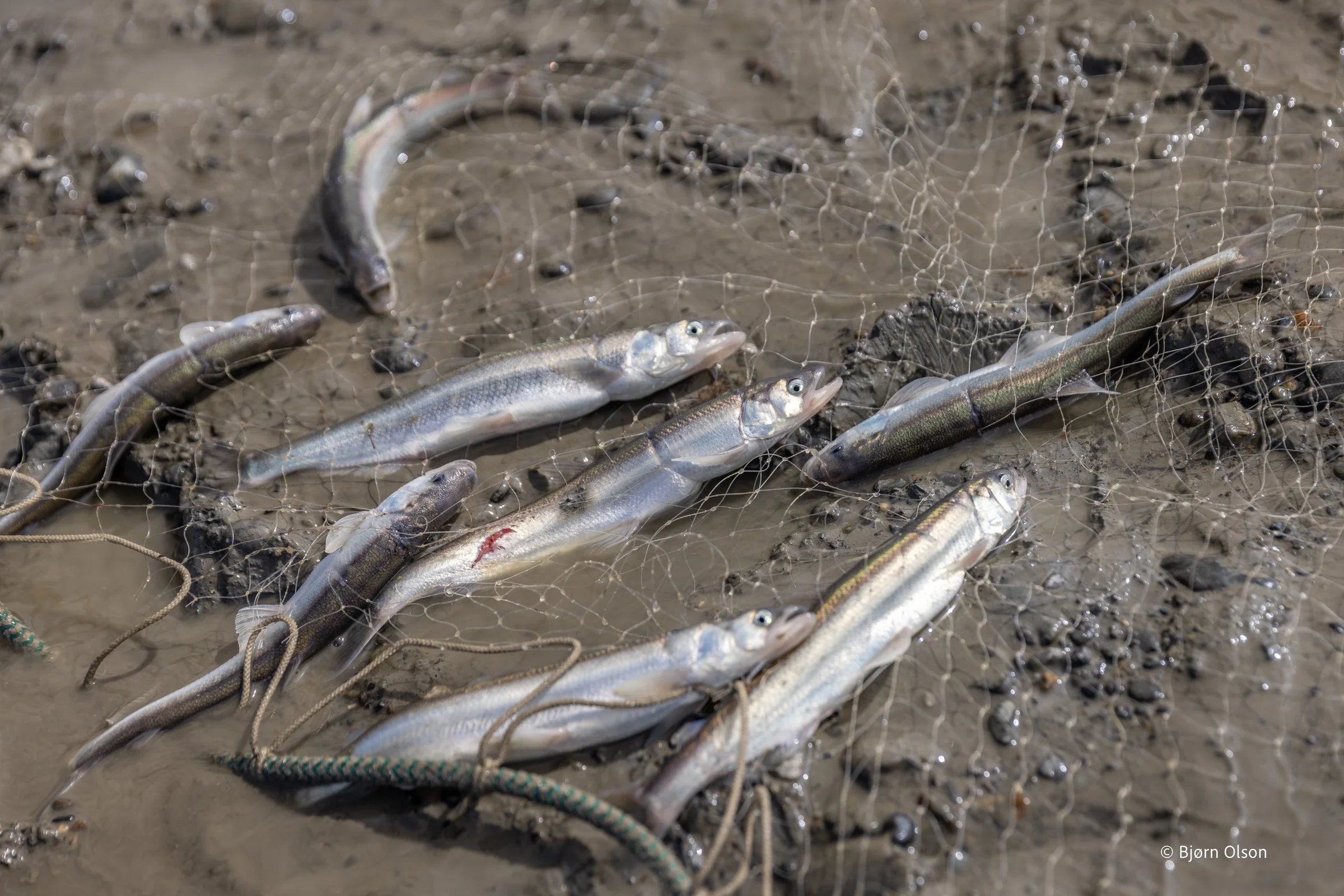
I cautiously make my way down the slippery, glacial silt riverbank. I am near the mouth, just upstream from an inlet that is famous for massive tidal fluctuations. The tide is out. Over my shoulder I carry a fourteen-foot-long pole with a gill net affixed to it, replete with a lead line and two buoys on each end.
I set down my five gallon bucket a few feet above the water line and wade into the river. Facing downstream with the net held out in my right hand perpendicular to the river, my feet lift off the bottom and I begin to float in the slow current.
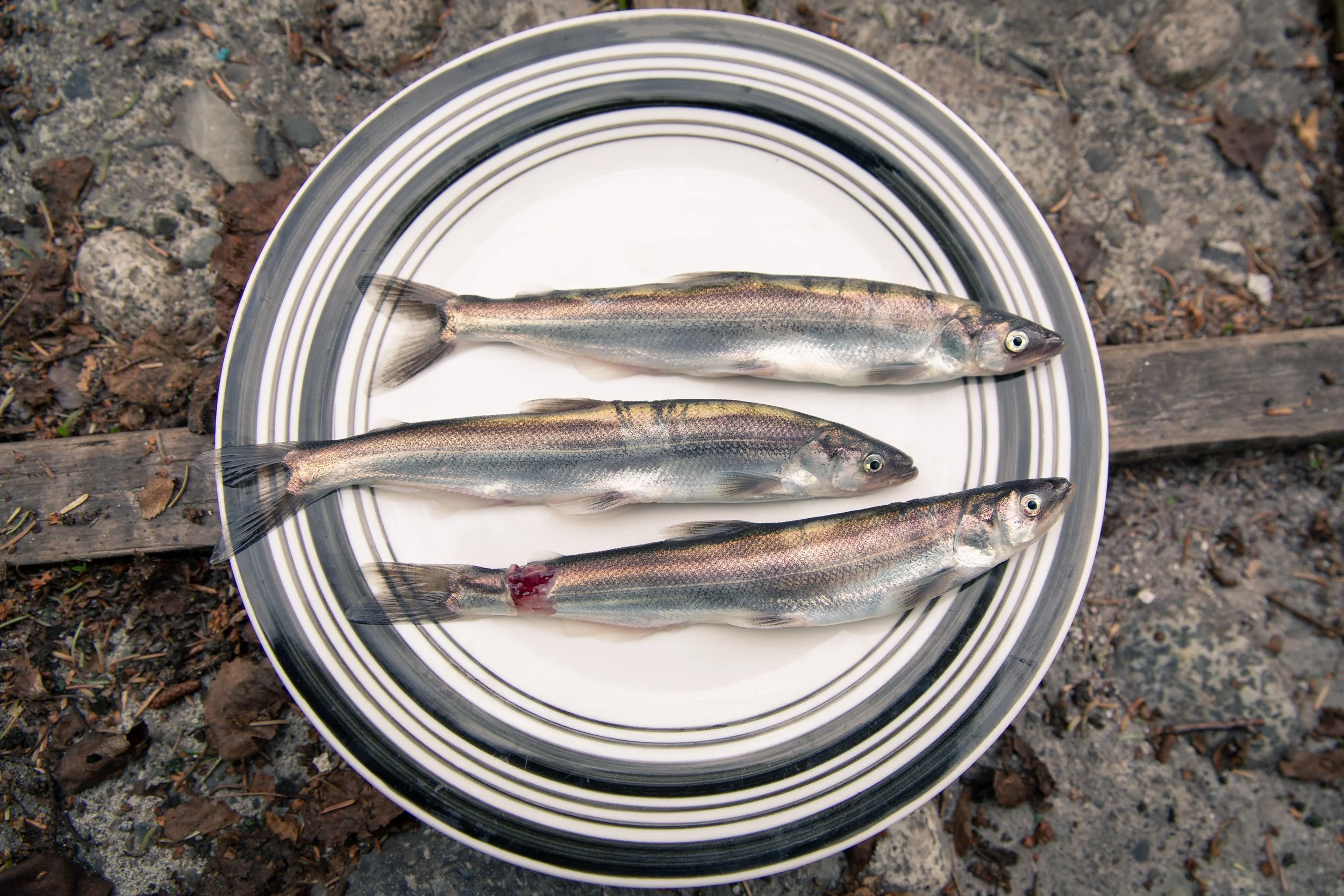
Immediately the net begns to intercept the small anadromous fishes, commonly called candlefish or hooligan, my life-partner and I are here for. These three-to four-inch-long fishes are in the smelt family; they are some of the highest fat-content fish on the planet and they are a nutritional powerhouse full of Omega 3s. Soul food.
As they hit my net, they wiggle and thrash, caught in the web. I keep it outstretched and float further downstream to the next patch of sandy beach where I make my way back to the shore to pluck them from the net and into our bucket.
Gulls and eagles swarm overhead in the morning offshore breeze. They too are here for the springtime pulse of the oil-dense fish on their way upstream to lay eggs and reproduce in the ceaseless cycle of life, death, and more life. A seal pokes its nose out of the water 15-feet away from me, taking a breather and glassing the above-water scene between gulps of the greasy, life-giving fishes.
Our annual hunting and gathering begins in the spring with these candlefish. Later we catch at least 35 salmon, a few halibut and rock fish; in the fall it is berries and mushrooms, caribou, moose, and or black bear.
In most years, 60 to 70 percent of our meals come from wild foods we either procure ourselves or receive as gifts from friends and family. The culture of wild-harvesting is a culture of gift-giving. The gratefulness I feel for each morsel is difficult to relate. These are some of the most nutrient-dense foods in the world. Their worth cannot be measured by a numeric metric.
Alaska is one of the few remaining places in the western world where people still heavily rely on subsistence foods. For thousands of years people thrived off the land, sea and air here in this high latitude corner of the world. The preservation of the interconnected dependencies of healthy and thriving ecosystems, that nourishes people and the vast web of other-than-humans, is the cornerstone of my politics.
This is not taken for granted. I see the writing on the wall and the way many people—the developers, the speculators, the politicians, the greed-heads—see the future of Alaska. Since childhood, I have stood in opposition to these people and those forces.
Being collapse-aware is to live on a razor's edge of potential futures. On the steeper slope of the blade is the grim outlook, one of feedback loops and extreme climate disruption that make our world inhospitable. A future of resource scarcity, of a terrified and deskilled populace that continue to elect and embolden statists, autocrats and fascists. In this future, the story of separation and alienation worsens, turning more and more of the living world into commodities and capital until all that is left is a toxic, dead desert.
The optimistic vision of the future I try to hold onto, despite having evidence to support it, is one where people recognize the value of their bioregions, re-learning and remembering how to care for their part of the world so it in turn can care for them, as Alaska has done for me throughout my life. In this vision of the future, the story of separation ends, animism and interdependence are rekindled, and community bonds are deepened.
In many parts of the world, if this future were to manifest, the uphill workload will involve regenerating and restoring the ravages industrial civilization has wrought—tearing down the dams, datacenters and pipelines, restoring grasslands, reintroducing keystone species, planting trees, and much more—work that is happening in isolated pockets around the world. Nature, these re-wilders are proving, desires to be restored. The same is true of the human spirit.
In Alaska, however, our task is arguably an easier one. Few places on the planet have been spared the ruin of industrial extraction and Alaska is no exception but there is biological diversity and abundance here that has yet to be irreparably despoiled. If there is going to be a future, this vast and diverse wildness must be preserved.
For many, Alaska is considered a resource extraction colony. The Russians of the 18th Century enslaved coastal peoples from the Aleutians to Southeast, decimating the sea otters, the Stellar’s sea cow and planted the first flag of colonialism in the hearts and minds of their victims.
Americans came with gold lust and then for the oil. At each of these pivotal times in history, the quest for wealth led to booms and busts and a new onslaught of greed-orientated migrants, some of whom stayed to affect and influence the self-image, politics, and outlook of all Alaskans.
The colonizers did not, however, entirely crush the epistemologies of Alaska’s First Peoples. Below the surface, essence of the old ways remains. Knowledge that stood the test of time for millennia. These elders and wisdom-keepers have been my guideposts when hope for a better future can feel subsumed by the power of civilization and the machine.
In every rural community and village in Alaska, evidence of the old ways is still fighting to be heard, honored and observed. If nourished, this wisdom can become the greater force, standing in opposition to the myths of growth, human exceptionalism, dualism, anthropocentrism, and civilization. This is my prayer.
Throughout Alaska, natural resources are in decline. Salmon numbers are failing, spruce forests are dying, Bering Sea crab have collapsed, and caribou herds are dwindling, to name a few. In a vision for a bright future, more and more people will help dismantle the mythology of growth and human exceptionalism, while rebuilding and remembering the fundamentals of our interdependence with the natural world.
I have felt the competition between these two distinct worldviews throughout my life—one, an ancient, place-based worldview steeped in reciprocity, mutual-aid, intuitive and deep ecology, with self-reliance and community well-being at its core. The other cosmology is anthropocentric, steeped in selfishness, aggrandizement, divorced from both nature and community.
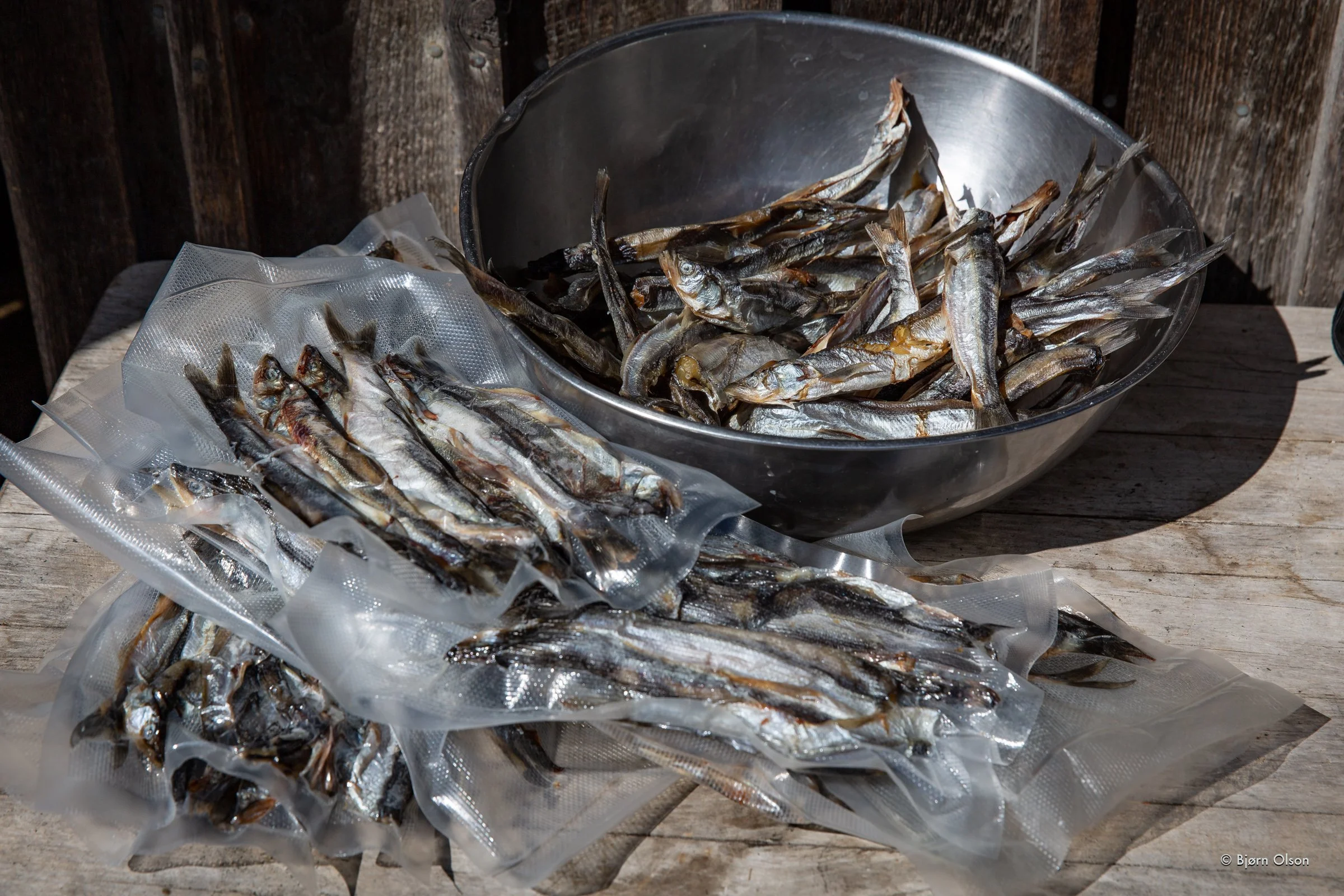
Back home from the river, the actual work begins. The run was good this year and we have seven gallons of the little fish that now need to be processed. I use a pair of scissors to cut the heads off, which drop into the bucket in front of me. I then snip the scissors up the belly and use one finger to scoop the guts and blood into the same bucket. The empty bucket on my right begins to fill with processed fish. Some are destined for the freezer, some for the smokehouse, and some are for tonight’s meal.
People around the world are waking up and beginning to comprehend that the promise of civilization is at a dead end. The lie that more technology will usher in a utopia has never sounded more absurd, even to those who promote it.
An ancestral longing to feel nested, connected and valued, to live lives with purpose, resides dormant within each of us. Civilization has malnourished our spirits and left us with a world in ruin. As their story of separation continues, the spirit of all life grows dimmer.
The pan sizzles as the skin of the candlefish begin to brown. A light dusting of sea salt is all I add to mine. The backbone and ribs slip off the cooked flesh. I stuff the first fish into my mouth and immediately feel a surge of heat and satiation. My body knows how to convert these fish into fuel and essential nutrients for my brain. This is ancient food, the food our species has eaten for countless millennia. We are exquisitely adapted to it. Now, more than any time in human history, is the time to remember what it takes to be nourished.